Showing posts sorted by relevance for query Maryland. Sort by date Show all posts

Thursday, March 14, 2013

Capturing the Title

I won the Glenn L. Martin Silver Cup in Boxing 
by Gary F.

My story goes back to 1947 and concerns Glenn L. Martin and the facility at Middle River, Maryland. Mr. Martin was an avid sports fan and encouraged participation in all sports. I was only 16-years-old at the time and won the Maryland State Bantamweight Boxing Championship when I defeated highly favored Pete Garibito of the United States Army. I was voted the outstanding boxer of the tournament and received the Glenn L. Martin Silver Cup (which I still have).

 I went on to the University of Maryland and then on to graduate school at Central Missouri State University earning master’s degree in safety. I joined Martin Marietta Aluminum in Oregon as a safety manager and was later transferred back to my roots in the Baltimore area working as safety manager at the Middle River aerospace plant. I had that Glenn L. Martin silver cup on my desk until I retired.

 A photo of me at my desk with that silver cup was featured in the company newsletter. I was also the Martin Marietta Management Club president for one year.

Wednesday, May 15, 2013

Postcard Memories

My parents began their careers in 1951
by Sheila H.

My name is Sheila. My parents Clyde and Marjorie were both employed by Martin Marietta for many years. They began their careers in 1951 at the Glenn L. Martin Company in Baltimore, Maryland. They both worked in the electronics department building the P6M SeaMaster and the P5M Marlin. In 1961, Martin Marietta opened a new plant in Orlando, Florida. My father was transferred to Orlando that same year. My mother was rehired a couple of years later. They both worked on the Pershing and Patriot missile programs. They both retired and were able to enjoy many happy and healthy years together. My father passed away in 2007 at 87 years old. My mother will turn 85 in a few months.

Glenn L. Martin Company, Baltimore, Maryland

Thursday, April 11, 2013

My Dad Began His Martin Career in 1939

At 95, he is proud to look back at wonderful memories
by James G.

My dad, Jim, turned 95 on Christmas Eve 2012! He began his career at the Glenn L. Martin Company in June 1939. Prior to his being drafted into the Army, he worked in manufacturing. He riveted aircraft frames and installed pilot controls and electrical systems. After World War II, he completed his degree at John Hopkins University and became an industrial engineer at the Martin facility in Essex, Maryland.

In 1962, he transferred to Denver as a chief industrial engineer, and he was part of the team that constructed and installed the Titan I and II sites throughout the United States. My dad always talks about the company parties when steamed crabs were shipped in from Baltimore. It was a heavenly treat for all of the employees, especially for the ones who used to live in Maryland!

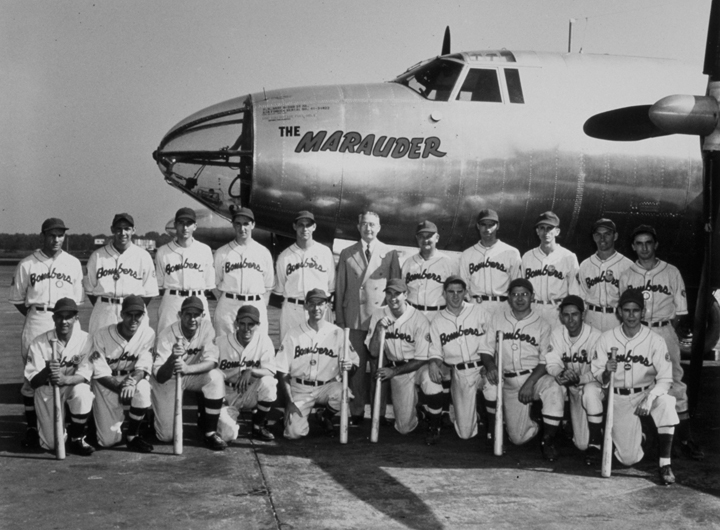
During his time at the Baltimore and Denver plants, he fondly remembers playing in the company golf league and the softball team dubbed the “Martin Bombers.” During those years, the camaraderie and teamwork was fantastic, and he made lifelong friends with his fellow workers. From 1978 until his retirement in 1982, he worked at the Michoud plant in Louisiana, where the external fuel tanks for the NASA Space Shuttle were manufactured.

Lockheed Martin has been a big part of his life and he is proud to be part of the greatest team that manufactured defense and space vehicles which made our nation strong.

Thanks Dad! You are the Greatest Generation!


Monday, September 17, 2012

We Never Forget!

An inspired moment made our mission crystal clear
by Steve T., Kelly H. and the CDBD Navy/Marine Corps Customer Focus Team

On an overcast October afternoon at Naval Air Station Patuxent River, Lockheed Martin’s Navy and Marine Corps Customer Focus Team’s interactive forum was well underway. Our government-industry team just had broken for the traditional celebratory cake honoring of the United States Navy’s 236th birthday. With the Admirals, captains, and their Lockheed Martin partners enjoying a quick bite on the Officer’s Club patio, the weather cleared and the F-35B “Lightning II” took to the southern Maryland skies.

Together, we stood transfixed, unexpectedly watching the jet that just days before had achieved the first, historic successful STOVL landing onboard USS WASP (LHD-1). Like excited children, we looked on with awe as history flew above us and a  fifth generation “concept turned into reality” circled and hovered above our heads.

When our break came to an end, so did Mother Nature’s clear sky. As the F-35B flew back to the hangar and we walked inside with our Naval customers, the Lockheed Martin team couldn’t hide its pride, knowing we were a part of the company, the team, providing this pioneering aircraft to our country and our maritime customer.

Right place, right time or just a bit of magic to remind us once again that we “never forget who we’re working for,” who knows? All we can say, it truly was an inspired moment celebrating Lockheed Martin Innovation, our customer and why so many of us come to work each day.

Thursday, April 25, 2013

Middle River Ingenuity

We were awarded a patent for an underwater ramjet
by Harold O.

It has been 40 years since I left Martin Marietta in Middle River, Maryland. where I had spent 18 years (from 1955 to 1973). I worked with two wonderful bosses during those years—William (Bill) Grey and Charlie Schell. Bill was my supervisor during the time I worked as an engineer performing jet engine performance calculations. At the time, Martin was competing on a contract with the Air Force for a new fighter/bomber. The company’s unique approach was to use water injection to increase thrust. Right after the announcement that we won, all the workers on the project were on a “high.” We were invited to a celebration party. Soon after this party the plant went on a short holiday, and when we returned we got the bad news that the contract had been cancelled. What a disappointment!

I was transferred to R&D where I worked on two interesting projects. They were calculating the heat transfer for the lunar drill, the drill that was used on the Moon and the research for an underwater ramjet, which I named “Marjet.” Charlie and l were awarded a patent (3171379 Hydro-Pneumatic Ramjet). Martin was awarded a Navy contract.

I left Martin Marietta in 1973 and went to work for Naval Air System Command (NASC) in Washington, D. C. At nearly 90, I am happily pursuing my hobby of coin collecting and keeping active by trying to help my bowling team (Hawks) win.

Friday, March 29, 2013

Rising through the Ranks

My story begins just after World War II
by Gerald S.

My story may be unique. I started my career working for the Glenn L. Martin Company in Essex, Maryland (C Building basement) in the fall of 1948 as a junior laboratory technician. I earned $1.45 per hour and was part of a group that designed one of the first United States electronic missile guidance systems. It was called the Oriol project. I left after two years to pursue my professional career.
About 10 years later, in 1961, I joined Lockheed Missile and Space Company as an engineering manager on the Agena program. Two years later, I was promoted and transferred to run a division of Lockheed Electronics Company. In 1969, I was again promoted to become president of the Lockheed Electronics Company and a corporate vice president of Lockheed.
What is unique is that I started with Martin, one member of the merged companies, at the bottom of the ladder. Twenty years later, I became a vice president of Lockheed, the other member of the merged companies.
One career path that involved two companies that in turn became one, gives me a strong sense of loyalty and pride in Lockheed Martin.

Thursday, May 30, 2013

Before Pearl Harbor

We found my father’s original badge and an uncashed check
by Susan Ross McN.

From the early to the present-day Lockheed Martin, the company has been a part of our family. Walter, my father, started working for the Glenn L. Martin Company in 1940, and the company employed him until he retired in 1982. After his death, we discovered his original Martin "star" badge and an uncashed payroll check for ten cents. We donated these items, as well as some other Martin memorabilia, to the Glenn L. Martin Maryland Aviation Museum in Baltimore..

Following my graduation from Kenwood High School in 1955, I was employed in the nuclear division and later in the presentations department. My husband, James, started working for the company in 1956 in the nuclear division. His employment continued on and off, until his retirement in 1994. We are both proud to be associated with Lockheed Martin.

We donated my father's "star" badge to the museum.

Monday, September 17, 2012

Filling in the Gaps

Family history includes stories of the Glenn L. Martin Company
by Michael L.

I don’t have much of a story, but I believe my grandmother, Louise Lawson, and father, Ernest Lee Lawson, Jr., both worked at the Glenn L Martin Company facility in Baltimore, Maryland. I'm almost 100 percent certain about my grandmother’s work. It was during World War II. My father’s account is a bit sketchy though (after Korean War). Both are now deceased.

Saturday, October 27, 2012

From Barnstorming to Baseball

Glenn L. Martin loved aviation and sports
by Nanette C.

My aunts told me stories that Glenn L. Martin would come to my grandfather’s (Wharton Drury’s) house to ask him to umpire Martin Bombers baseball games. My aunts told me what a big baseball fan Mr. Martin was! In fact, he helped form an organization called the All American Amateur Baseball Association (AAABA) to promote the sport.

My uncle told me that Mr. Martin asked the Darlington Maryland basketball recreational team to play the Martin Bombers in a pick-up game. Mr. Martin greeted all the Darlington players with a handshake and wished them well. After the Martin Bombers won by a significant amount, Mr. Martin shook the hands of all the players and stated they played a hard game and thanked them for playing. What a class act!


Glenn L. Martin and the Martin "Bombers"

Sunday, October 21, 2012

Five Generations of Continuous Employment

The journey’s been grand for our family
by Lorraine B.

My grandfather, Mathias Remesch, lived in Hungary where he was a master cabinetmaker and business owner. He immigrated to the United States in 1905 and was employed by the Glenn L. Martin Company in Cleveland, Ohio. When the facility moved to Maryland, he set up the first tool room at Middle River. 
For five generations, my family has been fortunate to have continuous employment at Middle River, and it all began with Mathias (first generation). The lineage includes my parents, Frank and Violet Remesch (second generation); my brothers, Frank and Raymond Remesch, and myself (third generation); my daughter, Nancy, and her husband, William (fourth generation); and my granddaughter, Stephanie, who interned in 2009 (fifth generation).

Yes, I was part of the 100-year history of the Glenn L. Martin Company and saw significant changes in the industry. Some of the legacy has been in the books, and some of it is not written. I witnessed the manual typewriter and adding machine changing to the computer age and the thousands of single machines in the shop changing to a single N/C programmed machine doing 50 operations. Talks about dress-down day, the guys in the shop were required to wear white shirts and ties (some wore aprons).

What a great company it was to work for and I conclude with my congratulations to Lockheed Martin on 100 years!

Saturday, February 23, 2013

Aviation Is in My DNA

We grew up in the Martin culture
by Joe W.

My father retired from Martin Marietta long ago. I grew up in a community called Essex, Maryland, that was almost a company town. The streets in the Aero Acres community near the plant were named after aircraft parts. When Dad was graduating from high school in 1929, he heard of job opportunities at the Glenn L. Martin Company. After he passed away, I found a letter he had written before graduating from high school saying that he had satisfied all his academic requirements and could start work in May if hired. Martin did hire him just before they opened the Middle River plant, and he worked his entire career there. We attended family days over the years and were excited to climb into cockpits of Martin aircraft. We grew up with pictures of Martin aircraft on our bedroom walls. My last memories when he worked there included an exciting transition to the space program. It was nostalgic for me when I went to work at Lockheed Martin in 2000.

Monday, May 13, 2013

After Martin Marietta

I’m still part of an important “club”
by Helen T.

I started working at the Glenn L. Martin Company in 1946 at Stansbury Manor, typing deeds and mortgages as the Aero Acres homes were sold. In 30 years, I had many bosses, including. Frank Vitek, Bill German, Bill Dietz, Bill Keimig, Andy Trost and Tim Hughes.

I was married twice. Ray Popp, my first husband, worked at Martin. We fell in love and were married in 1953. Ray was later laid off and went to work at Bethlehem Steel at Sparrows Point. I took early retirement in 1976, and we moved to Maryland’s Eastern Shore. Ray passed away in 1991, and I sold my home and moved back to Baltimore, joining RAMMs. Who should be at my first meeting but my old boss, Andy Trost. Again love bloomed, and we were married in 1993. We enjoyed visits to Andy's condo at Rehoboth Beach until his death in 2000. There must be something about those Martin men! I again found love with Bill Heinefield, a Martin retiree and secretary of RAMMs. We were inseparable for a year before his sudden death of a stroke in 2009.

I’ve been called the RAMMS cake lady. I bake two black walnut cakes, to be door prizes, at our RAMM dances, and two for our cake auction at our picnic. I am a regular “stuffer” for our monthly newsletter, and although I had to give up driving, I still found a way to attend RAMM meetings. I want to thank everyone for the generosity and support you've shown over the years!

I typed Aero Acres deeds and mortgages.


Monday, February 4, 2013

Rocketing into the Information Age

I was at the right place, at the right time
by Ralph G.

After graduating from the University of Florida in 1953, I went to work for the Glenn L. Martin Company in Baltimore, Maryland. Mr. Martin was still alive at the time. For the next four years, I worked on a variety of missile projects, including the MGM-1 Matador, the P5M Marlin, the P6M SeaMaster, the Titan and the MGM-18 Lacrosse. It was Lacrosse that brought me back to Florida to help open a new facility in Orlando in 1957.

A year later, the company acquired a new digital computer (wow, it was big). I was transferred for a “minimum of one year” to be a computer programmer. That year turned out to be 30 years, and my duties grew. During that time, computers became more prominent, a new part of the company was formed, and I was one of the earliest employees of Data Systems. Those 30 years resulted in a completely new part of my education. The company name changed from the Glenn L. Martin Company to the Martin Company and then to Martin Marietta. Progress was made, and for 35 years, I was a small part of that.

Sunday, January 27, 2013

A “Ghost” from Martin Marietta’s Past

I learned so much about my grandfather that day 
by John S.

During the war years, my grandfather, Frank J. Stankis, managed the Glenn L. Martin sheet metal plant in Baltimore, Maryland. Family albums show my grandmother and grandfather seated with Mr. Martin and Minta Martin at important company functions. Even before I went to work for Martin Marietta in 1980, I as keenly aware of the Martin Company. My father once said, “It’s been awhile since Dad worked for Mr. Martin, but perhaps someday you’ll see a ghost.”
That day arrived. In 1983, I received a telephone call from Dabby Dabkowski. Dabby, retiring after 47 years with Martin Marietta, asked me if I knew that Stankis was a famous name in the company’s history. I replied that I did know. Dabby then recounted that my grandfather had given him his first job on the Mars program, molding sheet metal. I always enjoy telling this story.
It was wartime and jobs were scarce. Dabby spoke of an exchange he had with my grandfather. Dabby remembered, “One day, I was hammering away and I noticed, out of the corner of my eye, that Frank was watching me. I was nervous, but I didn’t miss a stroke. In those days, if you messed up, you were immediately replaced. There was no time to break even for a Coca-Cola."
My grandfather asked, “How are you doing, son?” Dabby replied that he was fine. Granddad said, “Good, but I want to see more light between you and the workbench.”
Yes, it was a glimpse of the ghost my father had talked about!

Thursday, September 6, 2012

Making a 360

My father’s first job and my last job were for the same company
by Stephen B.

In 1946, after my mother and father served in the Navy during World War II, my father went to work for the Glenn L. Martin Company in Baltimore, Maryland. My parents lived on Dihedral Drive in Aero Acres, a community Mr. Martin built during the war for his employees. Many years later in 2004, when I went to work for Lockheed Martin in Hanover (not far from where they lived and where I was born), I always felt it was good karma that my father’s first job and my (hopefully) last job were for the same company. Although my father did not live to see me work for Lockheed Martin, every day I do my best to make him, the company, my customer and myself proud to be a Lockheed Martin employee. Thanks for that opportunity.

That's me on top of the car.


Tuesday, April 16, 2013

From the Sea to the Sky

My father and I share the heritage
by Thomas O’B.

My father, Kenneth, originally started with the Glenn L. Martin Company in the 1940s, I believe. He graduated from college with an aeronautical engineering degree, and worked on the seaplanes in Baltimore, Maryland. In 1959, he was transferred to the Waterton facility in Colorado and started working on the Titan rockets. He ultimately was asked to take an early retirement in 1975 after completing Mission Success work on the Viking program that went to the planet Mars. I worked for Martin Marietta in the procurement department until I was laid off in 1990, before the company became Lockheed Martin. I would love to somehow come back and work my last working days at Lockheed Martin.

Saturday, June 15, 2013

The Art and Science of Aviation

It was natural that one would want to work for Glenn L. Martin
by David B.
  
At the Glenn L. Martin Company in Middle River Maryland, in 1951, Mr. E. E. (Pete) Clark, the chief of aerodynamics, interviewed me for several hours, including lunch and afterwards. We agreed I should work there. It was the gift of a lifetime! Mr. Clark found out that I had built model airplanes all my life and had worked at a grass strip airport covering wings, welding and riveting, repairing, inspecting and modifying light planes. He found out, too, that I had earned a Bachelor of Science at Virginia Polytechnic Institute in aeronautical engineering. I had graduated with honors, and was placed number one in the class. I felt lucky to be hired.

Starting on August 2, 1951, the company assigned me to the Canberra project in the aerodynamics group. Joe Burghardt was the project engineer and Howard E. (Howie) Schick was in charge of stability and control, so I sat next to him. The English Electric Company had earlier delivered three Canberra aircraft to be used at Martin, and we still had WD932 and WD940, in the effort to turn it into the United States Air Force B-57. It required not just changing skin gauges and rivet sizes, but meeting MIL-SPEC-F-8785 ASG, the flying quality spec for piloted aircraft. It was said, at the time, that this was something to do with the balance of payments abroad, having to do with the war. This was hard to swallow, as we still had a Martin XB-S1 on the field, a really advanced aircraft with swept wings, two pod-mounted jet engines, a high T-tail, bicycle landing gear and other features to make it a really high-speed bomber. Later, it became clear that the Canberra had the greatest ratio of low speed to high speed of anything in the inventory, and this became increasingly important as we improved the high subsonic capability in flight test and then were invited to build a special purpose high-altitude variant. Wing Commander W. E. W. Petter had designed a beautifully streamlined, low-drag airframe with lightweight structure. He had chosen the equivalent of a NACA 0012 airfoil, inboard, which had plenty of room for deep spars but also avoided the early Mach problems over the upper surface of cambered airfoils. Contributing to low weight, he had avoided hydraulics on the controls, and used geared and spring tabs on the ailerons, elevator and rudder. All of this later enabled us to use the aircraft in a special high altitude variant—the BS7D.

These are my first memories at Martin. Thank you!

The Martin B-57 Canberra


Wednesday, September 5, 2012

What’s the Scoop?

The world's largest flying boats are still mighty warriors
by Michael W.

While visiting a supplier in Vancouver, British Columbia, I found out that I was a few miles from Sproat Lake. Anchored on this lake are two Martin Mars flying boats. These aircraft were built in the 1940s at the Middle River, Maryland, aircraft factory.

These have been converted to water bombers and are used to fight forest fires. After a brief tour of the base, I stayed to witness the water drop test that they do to maintain the aircraft to be ready to fight forest fires.
The huge aircraft taxied across the lake and took flight in minutes. The pilot then descended and skimmed across the lake at about 180 miles per hour. Two six-inch tubes extending from the bottom of the fuselage collected over 7,000 gallons of water in 25 seconds, stored in the internal tanks. The aircraft then disappeared into the sky. After about three minutes, it reappeared and flew over the dock that we were standing on. As though we were the intended target, it flew over us at an altitude of about 500 feet when it released the 7,000 gallons of water for a “test drop.” The crew had obviously done this before for onlookers, as the water missed us by about 200 feet and plummeted back into the lake. Even though the aircraft are now 66 years old, the “Hawaii” and “Philippine” Mars are still being used today and are ready to fight forest fires in a minute’s notice. 

Saturday, April 13, 2013

I Was a Riveter at “Boy’s Town”

I still have my first pay envelope
by George S.

I started work as a riveter on March 25, 1941, at the Glenn L. Martin Company in Middle River, Maryland, at 50 cents an hour. The company was affectionately called “Boy’s Town” due to the youth of the men working in this new field of aviation. I still have my first pay envelope, in which cash was the method of weekly payment. I worked on the first B-26 Marauders (except for a short break in the United States Army). I met Glenn L. and his mother, Minta, when she christened the “Martin Mars” flying boat in November 1942. Mr. Martin, an avid sports fan, built a baseball field in front of the engineering building and would watch as other employees and I played baseball. After my release from the service, I again worked on the B-26B and, later, the B-57 Canberra Bomber. I was promoted to supervision during this time. In 1960, I transferred to the Denver division. After many years working on Titan missiles, Skylab projects, and supporting launches at Vandenberg Air Force Base and in Florida, I retired in 1988. Now age 90, I’ve enjoyed 25 years of retirement, and retain fond memories of my experiences with the company. I have enjoyed many travels with my wife of 64 years, in great part due to the benefits provided by the company. My wife passed on in 2010, but I continue to enjoy sharing my memories with others. I could not have selected a better company for which to work. Many thanks.

A World War II Recruiting Poster

Monday, September 10, 2012

Copperhead’s “Venom” Was Deadly

I was awarded the Jefferson Cup in 1977 for work on its guidance electronics
by Francis C.

I arrived at Martin Marietta (Glen L. Martin Company) in 1955 at the Baltimore, Maryland, plant. I have had many rewarding design experiences. The following is the most memorable and challenging.

The customer was the Army in the early to mid-1970s. I derived the unique electronic packaging design solution that made it possible for a full complement of delicate, non-encapsulated guidance electronics to survive the mammoth force of 9,000 g's experienced during the cannon launch of the laser-guided Copperhead shaped charge warhead, anti-armor tank-killer projectile. The electronics drastically reduced the Copperhead production cost by $65,000,000 on the first production order. For this achievement, I was one of five Martin Marietta employees throughout the Corporation to be awarded the Jefferson Cup in Washington, D.C., in 1977.